
Flexible barriers
Flexible barriers and safety products
We offer our clients the best of the world of flexible and steel barriers. With the ranges of leading manufacturers McCue, STOMMPY, d-flexx and AnterSystem, we prepare several solution options and a quotation just for you.
Why flexible barriers
Protection that withstands repeated impacts
Flexible plastic barriers are made of a polymer that absorbs impact energy, bends and returns to its original shape. Unlike steel barriers, they do not deform, rust or damage the floor.
We build our solutions on products from McCue (Flex+ and SafeStop ranges), STOMMPY (Stommpy Original and Stommpy EasyFit), d-flexx and AnterSystem. We size each barrier according to what it needs to protect and from what.
We are happy to add to physical protection with anti-collision systems, which warn of danger before an impact happens, and virtual floor marking for pedestrian routes and zones.
- impact resistance, tested to PAS 13
- up to50,000J
- barrier height to stop falling goods
- up to6m
- warranty on barriers and 12 years on floors
- up to10years
- replacing a damaged part
- 15–30min
Benefits
Why choose flexible barriers?
- They have shape memory and return to their original form after an impact.
- They can withstand repeated impacts.
- They do not damage the floor, as impact energy is not transferred into the anchoring.
- They need no regular painting, do not corrode and are UV-stable.
- They are HACCP-certified for use in food production.
- They can be extended modularly and moved as your requirements change.
- With additional components, they can be integrated into automatic and active safety systems.
- They withstand impact energy of up to 50,000 J, with resistance tested to the PAS 13 standard.
- From the second impact onwards, they are cheaper to buy and maintain than conventional barriers.
What we protect
Flexible and steel barriers for people, racking, structures, doors and loading docks. From a single bollard to a complete system for a whole hall.
-
Pedestrian protection
Barriers separate pedestrian routes from forklift traffic. Available with reinforcement, fork protection or a floor-level barrier.
-
Racking protection
Protects rack uprights and rack ends from forklift impacts.
-
Protective bollards and column protection
Bollards from 125 to 200 mm in diameter, also available with LEDs and impact detection. Covers for structural columns and uprights up to 1.2 m high.
-
Machinery and equipment protection
Low floor barriers and stops protect lines, conveyors, electrical cabinets and refrigeration units from forklift forks.
-
Wall and building protection
Floor barriers along walls, sandwich panels and internal structures protect the building from forklifts and stored materials.
-
Door and passageway protection
Bollards, height restrictors and protective frames for the full door opening, including fire doors and flood doors.
-
Loading dock protection
Durable dock bumpers, truck wheel guides and barrier arms for dispatch docks. During loading, the truck is secured by the TDS system.
-
Safety gates
Swing, sliding and lifting gates, manual or motorised. Optionally with LED and audible signalling or card access.
-
Industrial fencing
Modular fencing and partition walls for indoor and outdoor areas, which can be combined with flexible barriers.
-
High barriers up to 6 m
They separate high-bay storage zones and catch falling objects weighing up to 2 t.
-
Barriers for heavy machinery
A heavy-duty range for places where machinery weighing 10 t or more operates.
-
Height restrictors
Protect sectional doors, walkways and passageways. The active version signals every impact with light and sound.
From real sites
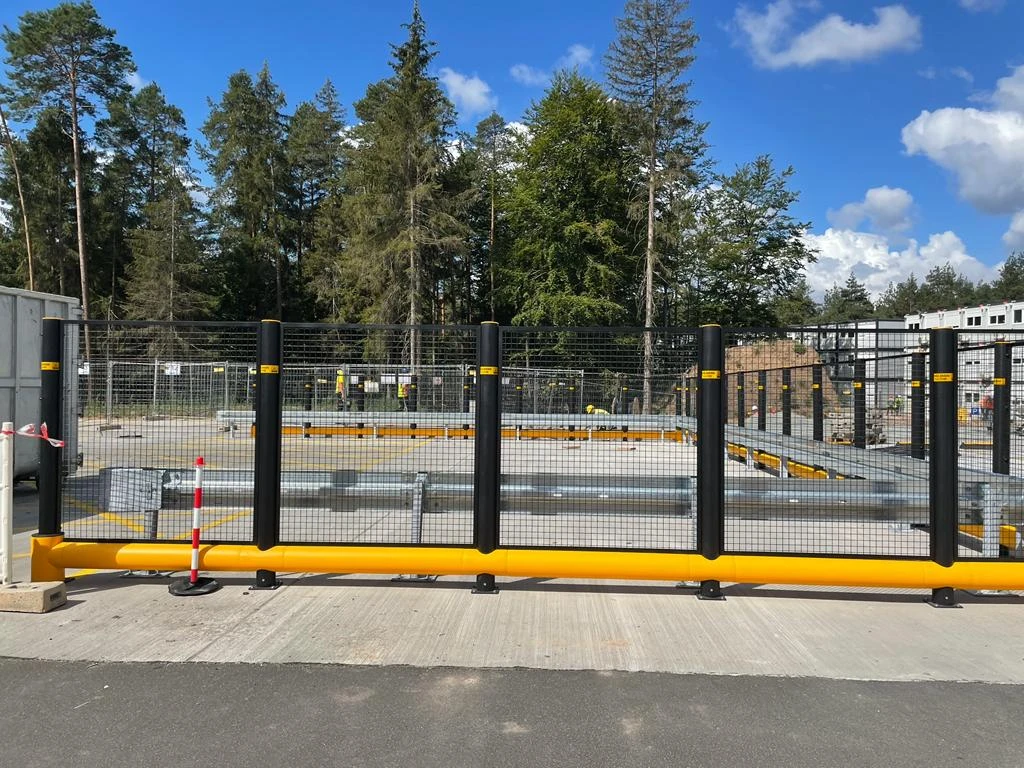
Outdoor fencing with yellow barriers 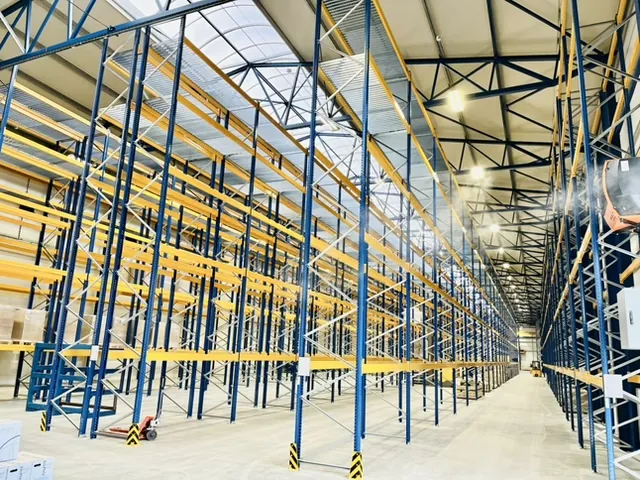
Racking protection in a new warehouse 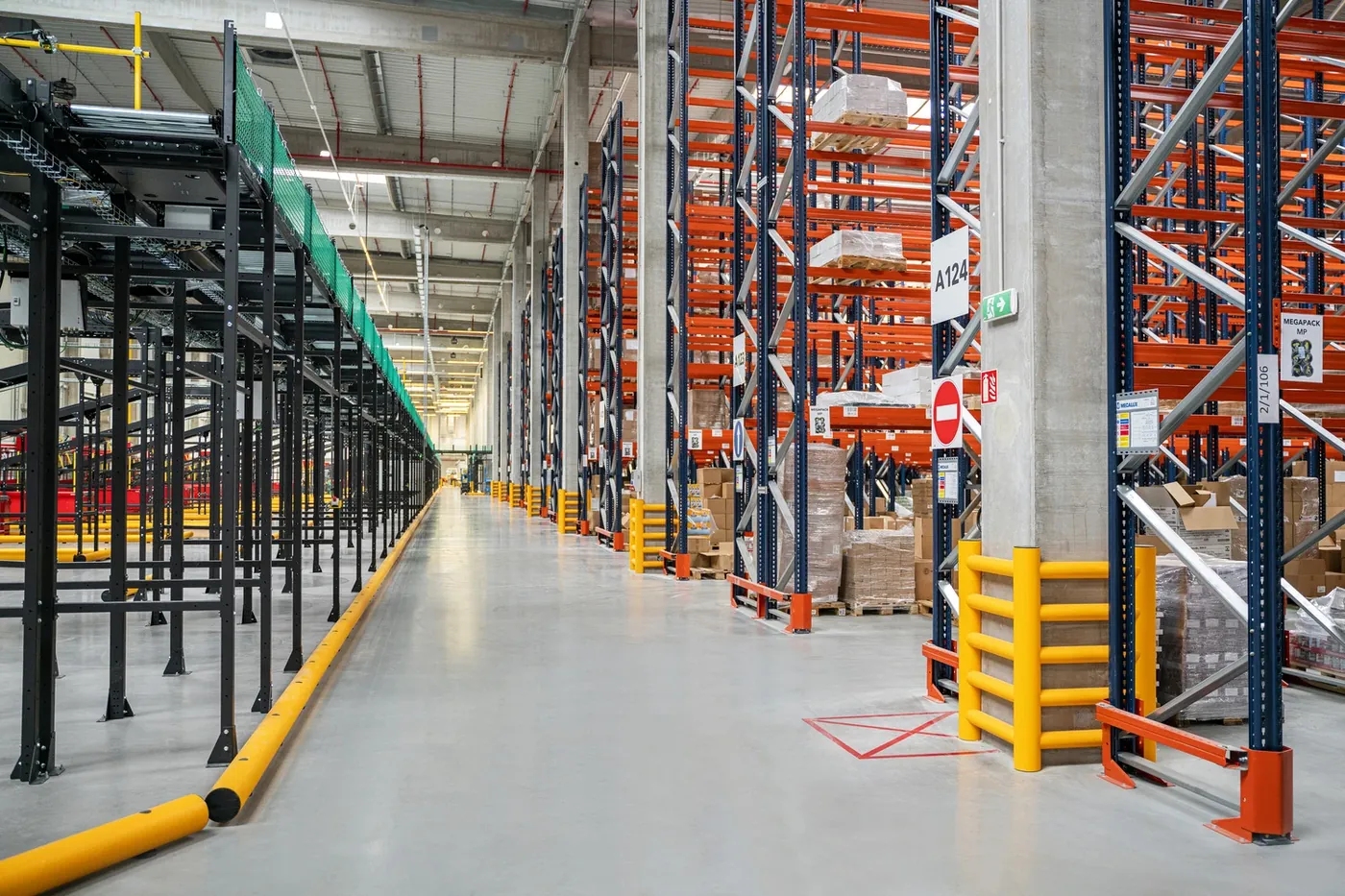
Protective elements in a warehouse aisle
Impact calculator
How do you choose the right flexible barriers?
The right choice is key to performance and long service life. Enter the weight and speed of the vehicle in the area you want to protect, and we will calculate the impact energy for head-on and angled impacts.
During the site visit, we also assess
- the most likely impact height
- floor material, composition and depth
- space constraints for installation
Head-on impact at 90°
19.3 kJ
required barrier resistance
-
Impact at 60°
14.5 kJ
-
Impact at 45°
9.6 kJ
-
Impact at 25°
3.4 kJ
We have a solution for you
Flexible barriers from our range withstand impacts of up to 50 kJ, tested to PAS 13. We choose the specific type based on the impact height and the floor.
This calculation is a guide only. We size barriers for a head-on impact, which is the most demanding. In an angled impact, the barrier takes only the perpendicular component of the speed: E = ½ · m · (v · sin α)².
Applications
Where flexible barriers are most often used
- Protecting doors, gates and loading docks
- Protecting structural columns and other elements
- Protecting pedestrians from materials handling equipment
- Protecting walls and parts of buildings from damage by forklifts and stored materials
- Protection against falling goods in high-bay storage
- Protecting rack uprights and rack ends
- Protecting electrical cabinets, enclosures and fire safety equipment
- Securing parts of warehouses against unwanted entry of people or unwanted movement of goods
- Guides and auxiliary elements for trucks and other transport vehicles
- Protecting passageways, platforms and other elements that limit clearance height
- Protecting fire doors, flood doors and partitions
- Protecting emergency exits, emergency routes and entrances to production or storage areas
Selected references
Flexible barriers protect manufacturing plants and logistics centres in the Czech Republic and Slovakia.




Our safety products come from brands including
Process
How we work together
Site visit
We come to you, walk through your site and measure the lighting conditions and risk zones.
Design
We prepare a safety concept or lighting calculation and compare the solution options.
Subsidies
We advise you on the subsidy options currently available.
Installation
We supply and install to your schedule, with as little disruption to your operation as possible.
Service
Regular maintenance, measurements and system adjustments when your operation changes.
Questions you often ask
FAQ
Are flexible barriers worth it compared with steel ones?
Yes. They return to their original shape after an impact, so they last much longer and need no maintenance or repairs. After a heavy impact, you only need to replace the damaged part. From the second impact onwards, purchase and maintenance work out cheaper than with conventional barriers.
Why do prices of flexible barriers vary so much?
Resistance is the main factor. Abrasion-resistant barriers can only cope with light equipment; most sites need impact-resistant barriers sized for a specific impact. The price also depends on the tested resistance in joules, the length of the warranty, the anchoring method and whether anchoring material is included.
What type of anchoring is best?
For truly flexible barriers, concrete anchors that hold the base platform. The bending of the material absorbs the impact energy and the floor stays undamaged. A central steel pin inside the post bends under a heavy impact and the post stays deformed.
How quick are delivery and installation?
Two installers can put up as much as 100 metres of barrier in one shift, so installation hardly restricts your operation. Delivery from the manufacturer usually takes 6 to 8 weeks.
Do flexible barriers need maintenance?
Practically none. The polymer does not rust or corrode, it withstands UV radiation and moisture and it needs no painting, even when scratched.
Can barriers be moved or extended?
Yes. The system is modular, so if your site layout changes, you can easily move it, add to it or extend it. Replacing a damaged part usually takes 15 to 30 minutes.
Are they suitable for food production or demanding environments?
Yes. We have a certified solution for operations running under HACCP. The barrier materials withstand chemicals and UV radiation and are non-flammable.