
Electronic safety systems
Active safety and anti-collision systems for warehouses and production
Most serious injuries in warehouses happen where people and forklifts meet. We offer a complete range of electronic systems that detect these risks in time, warn drivers and pedestrians and step in on their own in critical situations.
How it works
Systems that warn in time and step in on their own
We protect pedestrians from being hit, use forklift anti-collision (collision-avoidance) systems to prevent forklift collisions, and monitor speed in risk zones as well as loading docks.
The systems can be deployed individually or linked into a single whole with central data management in the cloud.
Where there is a risk of impact, we add flexible barriers, and virtual floor marking marks out pedestrian routes and zones.
- the pedestrian wears a small tag, which the detector picks up even without a direct line of sight
- RFID
- recognises pedestrians and forklifts from above the intersection, with no tags
- Radar
- tells people from forklifts and pallets, with no footage stored
- AI cameras
- data from all devices on one screen
- Cloud
Benefits
Why active safety
- Significantly fewer collisions in risk zones.
- Protects employees as well as visitors and external workers.
- The driver knows about a pedestrian before seeing them, even behind racking or a wall.
- No tags needed, thanks to radars and AI cameras.
- Forklifts slow down on their own where people are moving around.
- Physically restrains the truck at the loading dock, rather than just giving a light warning.
- Privacy protection: the image is processed directly in the camera, with no footage stored.
- All safety data in one place, with no paper records.
- Can help when negotiating lower insurance premiums.
Systems
Sixteen systems for pedestrians, forklifts, loading docks, machines and fleet management. For each one, you will find how it works and where it fits.
-
Pedestrian warning
The forklift driver knows about a pedestrian before seeing them, even when the pedestrian is behind racking or a wall.
-
Safe pedestrian crossing
A traffic light that shows the driver a pedestrian is approaching the crossing.
-
No-view zones / blind spots
Who has priority around a blind corner? The traffic light decides.
-
Traffic control: separating pedestrians and forklifts
When a forklift passes, the pedestrian gate locks. Automatically.
-
Light warnings on the floor
A warning sign projected right at people's feet, where they actually look.
-
Anti-collision system
Forklifts know about each other, even behind racking, at up to 40 metres.
-
Reduced-speed zones
The forklift slows down on its own, exactly where it needs to.
-
Narrow aisle safety
A traffic light at the aisle entrance shows that it is occupied.
-
Intersection guard
A smart traffic light above the intersection. Nobody has to wear anything.
-
Intelligent detection on the forklift
A camera that recognises people. No tags, no recording, in real time.
-
Intelligent detection in risk zones
It monitors blind corners and aisle exits around the clock, and nobody has to wear a tag.
-
Truck restraint at the loading dock
The truck cannot move from the dock until loading is finished. Mechanically.
-
Side-loading safety
When a truck driver enters the loading zone, forklifts slow down automatically.
-
Protection in hazardous areas
If someone falls onto a conveyor, the machine stops on its own. Proven at more than 100 sites.
-
Driver assistant
The forklift will not start until the driver logs in and passes a safety check.
-
Web-based safety platform
All your operational safety data on one screen, from a single hall or an entire warehouse network.
From real sites
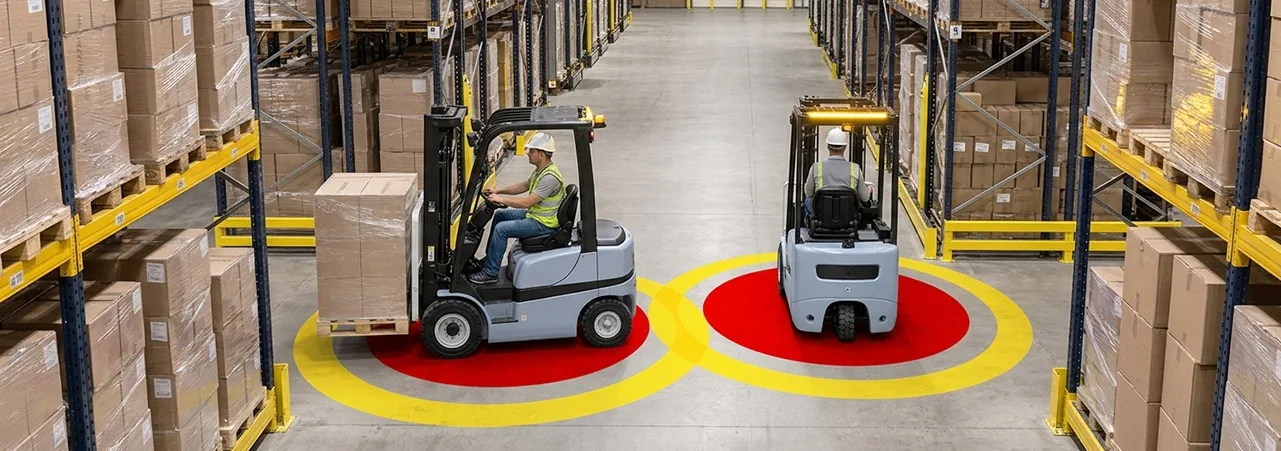
Anti-collision system: light zones around forklifts 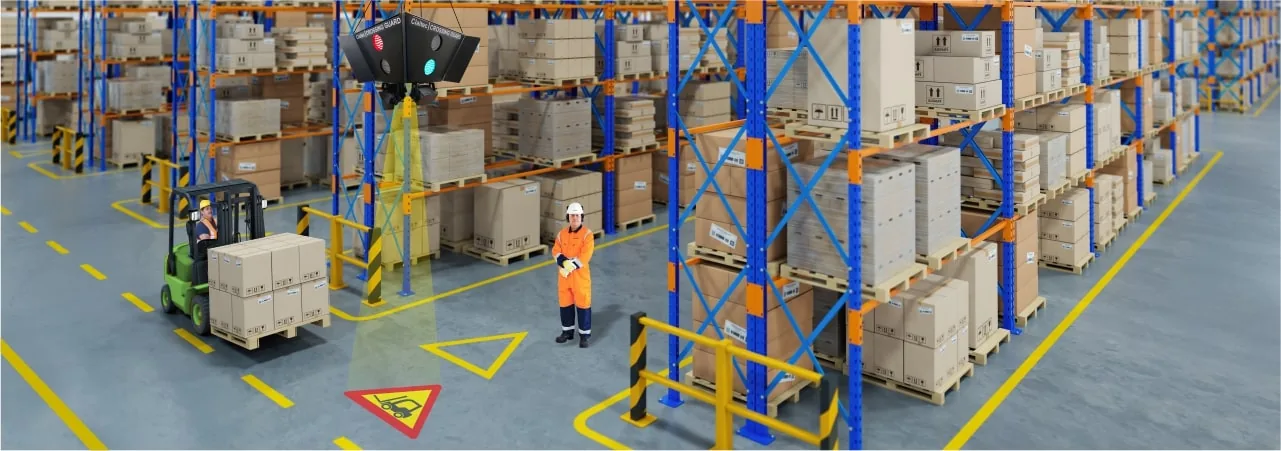
The intersection guard alerts pedestrians 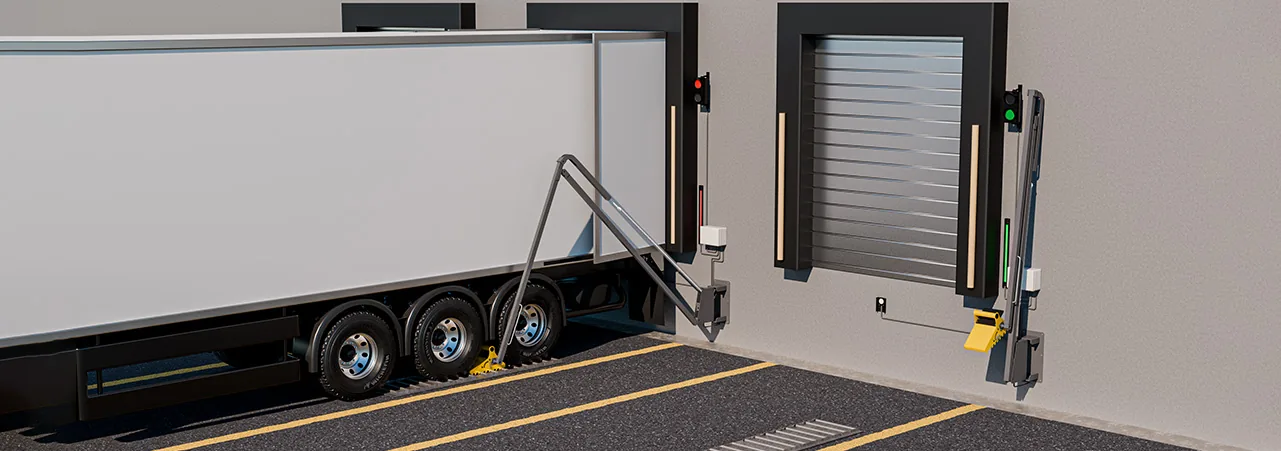
Truck restraint at the loading dock
Applications
Where active safety is most often used
- Loading and unloading zones
- Intersections with limited visibility
- Aisle exits between racks
- Narrow aisles between racks
- Pedestrian crossings in halls
- Production lines in confined spaces
- Loading docks, goods in and dispatch
- Outdoor loading areas
- Areas around presses, shredders and conveyors
- Recycling and waste sorting
- Warehouses, ports and logistics centres
- Sites where several drivers share forklifts
Process
How we work together
Site visit
We come to you, walk through your site and measure the lighting conditions and risk zones.
Design
We prepare a safety concept or lighting calculation and compare the solution options.
Subsidies
We advise you on the subsidy options currently available.
Installation
We supply and install to your schedule, with as little disruption to your operation as possible.
Service
Regular maintenance, measurements and system adjustments when your operation changes.
Questions you often ask
FAQ
Do pedestrians have to wear a tag?
With the PAS, PCS, BS and HA systems, yes: they wear a small fob. Crossing Guard with radar and AI cameras work without tags. They recognise people on their own, so they also protect visitors and external workers.
Can the systems be combined?
Yes. The systems can be deployed individually or linked into a single whole with central data management in the cloud. For example, PAS can be combined with a VAS projector or with Crossing Guard.
Will a system replace driver attention?
No. The cameras and COPILOT are assistance systems; the driver is always responsible for operating the forklift safely.
Do the cameras store footage or recognise faces?
No. They process the image directly in the camera, with no facial recognition and no footage stored. Faces can optionally be blurred automatically.
Does it also work outdoors?
Yes. The TDS system at the loading dock withstands rain and snow, and SLS monitors outdoor side-loading areas and is resistant to rain, dust and changes in lighting.
What if the Wi-Fi goes down?
COPILOT also works offline and sends its data as soon as Wi-Fi is available again. Real-time SAFEYU synchronisation requires Wi-Fi or a mobile signal.
Are the systems suitable for all forklifts?
CAS-G2 can be fitted to any type of industrial vehicle. PAS is designed for forklifts with a capacity of up to 3.5 t, both counterbalance and reach trucks, with an optimal speed of 6–8 km/h.